


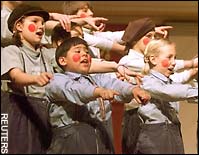
To commemorate Kristallnacht, Brundibar, a musical with concentration camp origins, was brought back to life for the first time in 60 years last week. The Berlin production of the musical, originally used by the Nazis in 1943 to present Theresienstadt as a model camp to international inspectors, was launched by Greta Klingsberg, one of the few original cast members to have survived.
Brundibar tells the story of Pepicek and his sister, Aninka, who try to raise money to buy milk for their sick mother by singing. But their voices are always drowned out by the deafening strains of the evil organ grinder Brundibar. They are finally saved by a chorus of friends, including a sparrow, a cat, a dog and other children from the neighbourhood, with whom they manage to outsing Brundibar. The opera was performed in Czech so that its thinly-veiled symbolism was lost on the Nazis.
Cast members had to be constantly replaced as more were transported to Auschwitz. Hans Krasa, the composer, and most of the cast, including Mrs Klingsberg’s co-star, were gassed in Auschwitz in October 1944. Prior to the Red Cross visit many inmates were deported to Auschwitz to reduce crowding. Those remaining were spoiled with food and drink. The failure of the Red Cross to uncover the horrors of the camp helped to seal Theresienstadt’s reputation as a “paradise ghetto”.
That Mrs. Klingsberg survived seems some sort of miracle. And the launch of this production seems at once a triumph and a mournful cry.





I saw a room devoted to the Maurice Sendak and Tony Kushner version at the Sendak exhibit in New York’s Jewish Museum a few months ago. Wonderful, gorgeous, passionate — just as one might expect from Sendak, in whose artistic career are major themes of coming to terms with Jewish history, especially the Holocaust, through children’s lenses. His favorite moment in art is in Mozart’s children’s opera The Magic Flute, where the despairing heroine Pamina is about to commit suicide when three boys restore her faith.
that pudgy kid needs his cheeks pinched